Have you ever driven down a highway and wondered why the route seems so… obvious? Like it’s taking the exact path you’d choose if you were traveling on foot?
I found myself asking this exact question last summer while road-tripping through Slovenia. My GPS kept directing me along roads that felt ancient—winding through mountain passes in ways that seemed almost intuitive. That’s when I spotted a small brown sign that read “Rimska Cesta” pointing toward a hiking trail.
Curious, I pulled over and started walking. Within minutes, I was standing on stones that Roman legionaries had marched on nearly 2,000 years ago. The path was slightly overgrown with moss, but the massive fitted stones beneath my feet were unmistakably man-made—and unmistakably Roman.
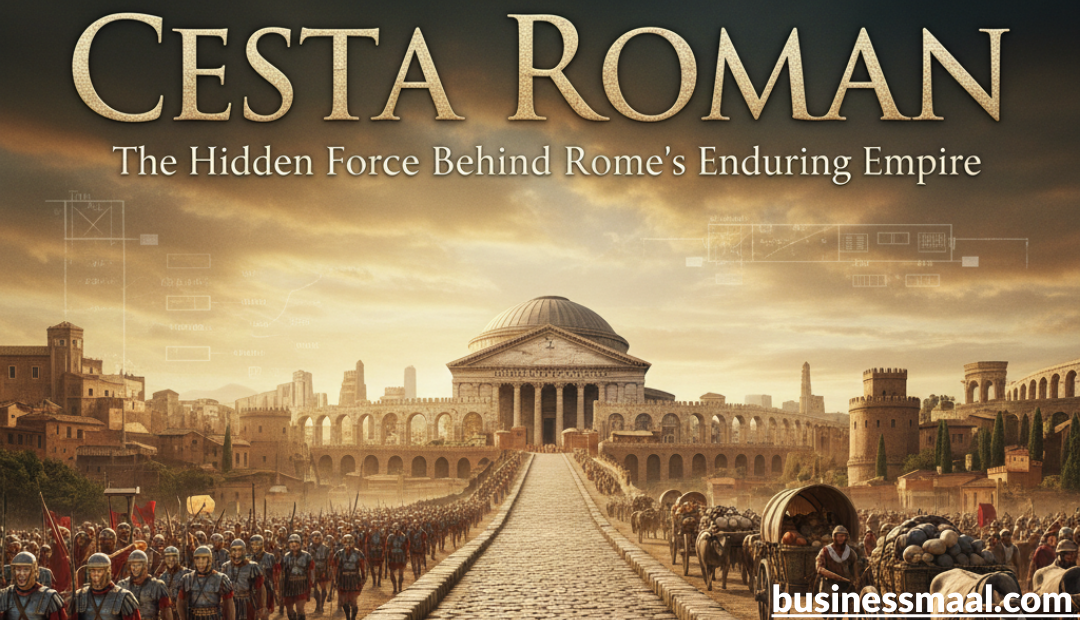
That’s when it hit me. We talk about Roman emperors, Roman generals, Roman senators. But we rarely talk about the real hero behind the empire’s success: the Cesta Roman—the Roman road.
Let me take you on a journey to discover why these ancient highways weren’t just paths through the dirt, but the actual nervous system that kept the world’s greatest empire alive for over a millennium.
What Exactly Is a “Cesta Roman”?
Before we go any further, let’s clear up the terminology. If you’ve searched for this term and found confusing results—maybe even something about baskets or chests—you’re not alone.
Here’s the simple truth: in Slovenian, Croatian, and other Slavic languages, “cesta” means “road” or “street.” “Rimska cesta” literally translates to “Roman road.”
So when I talk about the Cesta Roman, I’m talking about the network of Roman roads that stretched across Europe, the Middle East, and North Africa. At its peak, this system covered over 400,000 kilometers of roads, with more than 80,000 kilometers paved—enough to circle the Earth twice.
But here’s what blows my mind: these weren’t just dirt tracks. They were engineered highways that connected an empire stretching from Britain to Babylon, from the Rhine River to the Sahara Desert.
The Roads That Built an Empire
Moving Armies at Lightning Speed
Imagine you’re a Roman general in 100 AD. A rebellion breaks out in Gaul (modern France). How quickly can you get troops there?
Without the roads, you’d be looking at weeks of slogging through mud, crossing unmarked rivers, and losing soldiers to exhaustion and ambushes. With the roads? Roman legions could march 30 kilometers a day in full armor—on a good day, even more.
The Roman military depended entirely on this mobility. The viae militaris (military roads) meant that troops, supplies, and messages could move faster than anyone else in the ancient world could imagine.
Think about it this way: before the Romans, moving an army was like pushing a boulder through sand. After the Romans, it was like rolling that same boulder down a paved highway.
The Economic Superhighway
But the roads weren’t just for soldiers. They were for merchants, too.
The most famous trade route running through what’s now Slovenia was part of the legendary Amber Road. Wealthy Romans couldn’t get enough of amber—that golden, fossilized tree resin they called “northern gold.” It came from the Baltic Sea, and it had to travel thousands of kilometers to reach Rome.
The Roman roads made this possible. Along these stone-paved highways flowed not just amber, but:
Olive oil from Spain (millions of liters annually)
Grain from Egypt and North Africa
Wine from Gaul and Italy
Marble from Greece and Turkey
Spices, silks, and perfumes from as far away as India and China
Without the roads, Rome would have starved. Literally. The city of Rome needed to import hundreds of thousands of tons of grain every year just to feed its population. The roads (and the sea routes they connected to) made that possible.
The Engineering Secrets That Made Roads Last 2,000 Years
Here’s where it gets really interesting. How did Roman roads survive while our modern roads develop potholes after one winter?
I asked myself this while standing on that forest path in Slovenia. The stones under my feet had been there since Emperor Trajan was in power. And they weren’t going anywhere.
The Roman Road Recipe
The Romans didn’t just throw down gravel and hope for the best. They engineered their roads like they engineered their aqueducts—with precision and over-engineering that bordered on obsessive.
Here’s the basic recipe for a Roman road:
The Trench (Fossa) : They dug down until they hit solid ground or bedrock. No soft soil allowed.
The Foundation (Statumen) : Large, flat stones were laid at the bottom. These distributed the weight and prevented sinking.
The Base (Rudus) : A layer of concrete-like material—rubble mixed with mortar—was poured on top. This created a solid, interlocked base.
The Core (Nucleus) : Finer concrete and sand created a smooth, compact middle layer.
The Surface (Summa Crusta) : Large, polygonal stone slabs were fitted together like a giant jigsaw puzzle. These were cut so precisely that you couldn’t slide a knife between them.
The Genius Trick That Made All the Difference
But here’s the secret weapon that most people don’t know about: cambering.
If you look at a well-preserved Roman road section, you’ll notice it’s slightly higher in the middle than on the edges—just a gentle curve, like the crown of a modern road. This forced rainwater to drain off into ditches on either side.
Why does this matter? Because water is the enemy of roads. It seeps into cracks, freezes, expands, and breaks everything apart. The Romans knew this 2,000 years before we invented asphalt.
That simple curve—that attention to drainage—is why Roman roads survived while medieval roads turned into mud pits. It’s why you can still walk on Roman roads today while the Roman Empire itself has crumbled to dust.
More Than Just Pavement: The Roads as a Political Tool
Uniting a Continent
Here’s something I’ve come to believe after studying Roman history: the roads weren’t just practical infrastructure. They were a political statement.
Every time a Roman road stretched into a new province, it sent a message: “You are part of something bigger now.” The roads connected distant Britons to Egyptians, Spaniards to Syrians. Goods, ideas, and people moved along these stone arteries, slowly creating a shared identity.
The Romans understood something that many empires missed: you can’t rule millions of people through fear alone. You need them to feel connected. You need them to see themselves as part of the project.
The roads made that possible.
The World’s First Mail System
Ever wonder how the Roman emperor knew what was happening in distant provinces? The roads.
Augustus established the cursus publicus—the imperial courier service. Along the major roads, relay stations were set up every 30-40 kilometers, with fresh horses and riders ready to go. A message could travel from the Rhine frontier to Rome in days, not weeks.
This was the ancient equivalent of the internet. Information flowed faster than ever before in human history. And information, as we know, is power.
Where You Can Walk the Cesta Roman Today
If I’ve sparked your curiosity (and I hope I have), you might be wondering: can I still see these roads?
Absolutely. And you don’t need a time machine or an archaeology degree.
The Urban Experience
In Ljubljana, Slovenia’s charming capital, you can visit the remains of the Roman town Emona. There’s actually a street named Rimska cesta—Roman Road—right in the city. While modern asphalt covers most of it, the City Museum of Ljubljana and nearby archaeological parks show you the original stones.
It’s surreal to stand in a modern European city and realize you’re looking at the same pavement Roman merchants walked on while shopping for amber.
The Wild Experience
For the real magic, though, head out of the city. Near the towns of Logatec and Vrhnika in Slovenia, marked hiking trails follow the original Roman road through deep forests.
Here’s what you’ll find: moss-covered stone paths winding through ancient woods. The stones are worn smooth in places, and if you look closely, you might see ruts carved into them—grooves worn by iron-rimmed wagon wheels over centuries of use.
I’ll never forget walking that path. The forest was quiet—just wind in the trees and birdsong. And beneath my feet, stones that had felt the weight of legionaries, merchants, slaves, and emperors. You can’t get that experience in a museum. You can’t get it from a book.
You can only get it by walking the road yourself.
Why the Cesta Roman Matters Today
Here’s my honest opinion: we’ve gotten lazy about infrastructure.
We patch potholes instead of rebuilding roads properly. We take shortcuts that the Romans would never have tolerated. And then we wonder why our roads fall apart after a few harsh winters.
The Romans built for the ages because they believed their empire would last for the ages. They built roads not just for themselves, but for their children and their children’s children.
What does it say about us that we can’t seem to build anything meant to last beyond the next election cycle?
I’m not saying we need to go back to hand-fitting stone slabs on every highway. But I think we’ve lost something—that sense of responsibility to the future, that commitment to quality that defined Roman engineering.
The next time you’re stuck in traffic on a crumbling highway, think about the Cesta Roman. Think about roads that lasted 2,000 years while our roads struggle to last 20. And ask yourself: what are we building today that will still be standing in the year 4000?
Your Turn: Walk the Path
If you ever find yourself in Central Europe, do yourself a favor. Find a “Rimska Cesta” on the map. Take the detour. Walk the path.
Wear good hiking boots—those ancient stones can be slippery when wet. Bring a camera. And give yourself time to just… be there. Touch the stones. Imagine the people who walked there before you.
Because here’s the thing about the Cesta Roman: it’s not just a road. It’s a connection across time. It’s proof that ordinary people—soldiers, merchants, slaves, builders—were part of something extraordinary. And it’s a reminder that the things we build can outlive us, if we build them well.
Have you ever walked an ancient Roman road? I’d love to hear about your experience. Drop a comment below and share your story—or ask me anything about planning your own “Roman road adventure.” And if you know someone who’s obsessed with history (or just loves a good road trip), share this post with them. Some journeys are too good to keep to yourself.