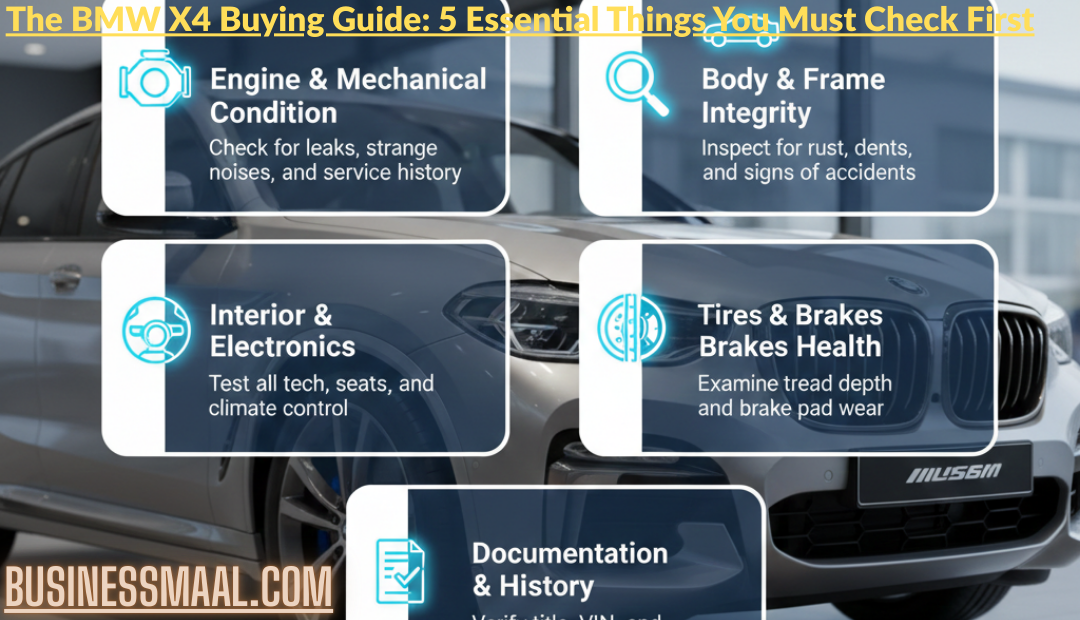
So, you’ve got your eye on a BMW X4. I get it. There’s just something about that sleek, coupe-like roofline sitting on top of an SUV body that grabs your attention. It’s sporty, it’s luxurious, and it stands out from the sea of boring boxy SUVs on the road. I remember the first time I saw one in a parking lot a few years back; I literally walked around it three times just to admire the lines.
But here’s the thing I’ve learned from buying and selling a few cars in my day (and making a few expensive mistakes along the way): falling in love with the looks isn’t enough. You have to go in with your eyes wide open. Whether you’re looking at a brand-new 2025 model or a used previous generation, there are some critical things you need to investigate first to make sure you’re getting a gem and not a money pit.
That’s where I come in. Think of me as your car-savvy buddy who’s here to walk you through the process. This isn’t a boring lecture; it’s a conversation about the BMW X4 buying guide checklist I wish I had when I was shopping. Let’s pop the hood and dig in.
Understand the “Coupe” Compromise: Space and Visibility
Okay, let’s tackle the elephant in the room right away. That gorgeous, fastback sloping roof that makes the X4 look like a sports car? It comes with a price, and I’m not just talking about the sticker.
Rear Seat Realities
I once took a friend to look at an X4 because he was convinced he wanted one. He sat in the driver’s seat, loved it. Then he got in the back. His exact words? “Whoa, my head is touching the roof.” . If you regularly carry adults—or even teenagers—in the back, you must have them sit back there during the test drive. Legroom is decent, but that sloping roof eats into headroom in a big way . It’s fine for kids or shorter trips, but for a family of tall people on a cross-country road trip? It might get cramped, fast.
The Cargo Compromise
The same goes for your stuff. Pop the hatch, and you’ll notice the opening isn’t as tall or as square as a traditional SUV like the X3. You’re giving up a good chunk of cargo space for that style—about 12 cubic feet less than its more practical sibling, the X3 . It’s still got 18.5 cubic feet behind the rear seats, which is plenty for a weekly grocery run or a couple of suitcases . But if your idea of a good time involves hauling furniture from IKEA or packing the car to the gills for a camping trip, you need to be realistic about how much stuff you can actually fit.
Get Real About the Running Costs
Let’s be honest, a BMW isn’t a Toyota Corolla. It’s a premium German machine, and it expects to be treated like one. Before you sign on the dotted line, you need to have a heart-to-heart with your wallet about what it costs to keep one of these on the road.
Maintenance Schedules Are Not Suggestions
BMWs have “Condition Based Servicing,” which means the car tells you when it needs love, usually around every 10,000 miles . But here’s the kicker: you cannot skip these services. If you’re looking at a used model, the first thing I’d do is ask for the service records. A well-maintained X4 with full service history is worth its weight in gold. A neglected one? That’s a ticking time bomb. For example, spark plugs and engine air filters are due around the 60,000-mile mark . If you’re looking at a car with 65,000 miles and those haven’t been done, you’ve got immediate negotiating power—and an immediate expense coming your way.
The Real Cost of Repairs
I have a buddy who bought a luxury SUV without checking the repair costs first. He almost choked when he needed a simple sensor replaced. According to RepairPal, the average annual repair cost for a BMW X4 is around $752, which is a bit higher than the average for luxury midsize SUVs . It’s not just about the oil changes; it’s about the potential for things like brake jobs (which are pricier on performance cars) or the 48-volt mild-hybrid system in the newer M40i models . It’s sophisticated tech, and when it breaks, it’s not cheap to fix. My advice? Check out the warranty situation. Newer models come with a 4-year/50,000-mile warranty, which is great peace of mind .
Choose Your Engine (And Your Fuel Budget) Wisely
This is the fun part. The BMW X4 comes in a few different flavors, and picking the right one is crucial to your happiness. It’s not just about speed; it’s about your daily driving style.
The xDrive30i: The Daily Driver
This is the base engine, a 2.0-liter turbocharged 4-cylinder that puts out a very respectable 248 horsepower . You know what? For most people, this is more than enough. It’ll get you from 0-60 in about six seconds, which feels plenty quick in the real world . It’s zippy, handles great, and gets decent fuel economy—around 24 mpg combined . If most of your driving is commuting and weekend errands, this is the smart, fun, and efficient choice. It’s the one I’d probably get, just to save a few bucks at the pump.
The M40i: The Sweet Spot
Now, if you’re an enthusiast like me, the inline-6 engine in the M40i is pure poetry. With 382 horsepower thanks to its mild-hybit system, this thing moves . It hits 60 mph in a blistering 4.4 seconds . I drove one once on a winding back road, and the sound of that engine… chef’s kiss. It also comes with an adaptive M suspension, making it handle like a dream . But, and it’s a big but, you pay for that thrill. The fuel economy drops to 23 mpg combined, and it requires premium fuel . If you have a heavy foot and a commute, be prepared to visit the gas station frequently.
The Full-Blown X4 M: The Race Car
Then there’s the X4 M. With 473 horsepower (or 503 with the Competition package), this is a rocketship disguised as an SUV . It’s incredible, but for 99% of people, it’s overkill on public roads. It’s also thirsty, getting only 17 mpg combined . Unless you’re planning on tracking your SUV, the M40i is the much more livable daily driver.
Check for Common Faults (Don’t Skip This!)
Okay, this is the part where I put on my detective hat. Every car has its quirks, and the BMW X4 is no different. Before you buy, especially if it’s a used model, you need to be aware of some common issues reported by owners.
Engine Mounts: Over time, the engine mounts can wear out. If you feel excessive vibrations or hear a clunking noise during acceleration, that’s a red flag .
Timing Chain Concerns: This is a big one for some BMW engines. A failing timing chain can sound like a rattling noise from the engine, especially on startup. If ignored, it can lead to catastrophic engine failure . If you hear any strange rattles, walk away or insist it gets fixed immediately.
Parking Sensors and Electronics: These cars are packed with tech, which is great until it glitches. Keep an eye out for faults with the Park Distance Control (PDC) sensors—often caused by dirt, damage, or electrical gremlins—and check that all the USB and Bluetooth connections work seamlessly . There’s nothing more annoying than a car that won’t connect to your phone.
Brake Wear: Pay attention to how the brakes feel. A spongy pedal, vibrations, or squealing are signs the system needs attention .
Taking the car for a thorough test drive on various road surfaces will help you suss out a lot of these issues.
Decode the Depreciation and Pricing
New cars lose value the second you drive them off the lot, and the BMW X4 is no exception. But understanding this can actually work in your favor.
New vs. Used: The Smart Money Play
According to Kelley Blue Book, a 2024 BMW X4 xDrive30i that originally had an MSRP around $56,000 now has a Fair Purchase Price of about $39,800 . That’s a massive drop in just one year. If you’re looking to save some serious cash, a certified pre-owned (CPO) model that’s just a year or two old is often the smartest financial move. You let the first owner take the big depreciation hit, and you still get a nearly-new car with plenty of warranty left. The 2025 model starts around $56,475, so you have to ask yourself if that “newness” is worth an extra $15,000+ to you .
The Cost to Own
Beyond the purchase price, look at the “five-year cost to own.” For a 2025 X4, that number can be around $92,000 when you factor in depreciation, fuel, insurance, and maintenance . That sounds scary, but it’s par for the course in this segment. Just knowing that number helps you budget realistically. You’re not just buying a car; you’re buying into a lifestyle with associated costs.
Conclusion: Is the BMW X4 Right for You?
So, after all that, would I buy a BMW X4? Honestly? If the style speaks to you and you can live with the slightly tighter space, absolutely. It is one of the best-driving SUVs in its class. It’s athletic, it’s luxurious, and it makes you feel special every time you get behind the wheel .
Just don’t buy it with your heart alone. Use this BMW X4 buying guide as your roadmap. Check the service records, understand which engine fits your life, budget for the higher upkeep, and make sure that back seat works for your actual passengers.
Have you driven an X4 before? Or are you cross-shopping it with something like the Audi Q5 Sportback? I’d love to hear your thoughts! Drop a comment below and let’s chat. And hey, if you found this guide helpful, share it with a friend who’s also looking at luxury SUVs.