You know what’s crazy?
I spent six months “preparing” to start my first blog. I bought courses. Read every SEO guide. Organized my folders perfectly.
But I published nothing.
Sound familiar? You tell yourself you’re not ready yet. Just one more book. One more video. Then you’ll act.
Here’s the truth I learned the hard way: Learning without action is just a hobby.
Today I want to share a simple concept that broke me out of that loop. It’s called duaction. And once you get it, you’ll never hide behind “research” again.
What Is Duaction? (And Why Most People Get It Wrong)
Let me define it plainly.
Duaction is the intentional balance of learning and doing at the same time. Not one then the other. Both. Right now.
Most people swing like a pendulum. They spend weeks in “learning mode.” Reading. Watching. Highlighting.
Then they panic and jump into “action mode.” No plan. No strategy. Just chaos.
Duaction says no to both extremes.
Think of it like riding a bike. You don’t read a 200-page manual on balance first. You also don’t just jump on and close your eyes.
You learn a little. Try it. Fall. Adjust. Learn one more thing. Try again.
That’s duaction.
The Trap I See Every Single Week
Last week, a client told me she wanted to start a podcast.
“I’ve listened to 40 episodes about podcasting,” she said. “Bought a microphone. Even designed my cover art.”
“Great,” I said. “When does your first episode drop?”
Silence.
She hadn’t recorded a single word. Because she was stuck in what I call the learning loop. It feels productive. It’s not.
I’ve been there too. When I started my first business, I read 27 books on marketing. Twenty-seven.
You know how many sales I made? Zero.
Because I hadn’t actually talked to a single customer. Learning had become my excuse to avoid the scary part.
The 3-Step Duaction Framework That Actually Works
Let me give you something you can use today. Not next week. Today.
Set a Learning Time Limit
Here’s my rule. Spend no more than 20% of your time learning before you take action.
Want to learn Facebook ads? Give yourself two hours of research. Then set up a $5 test campaign.
Writing a book? Read one chapter on character development. Then write one page.
Learning without a deadline is just procrastination in a pretty dress.
Use the “Small Bet” Method
I learned this from a friend who runs a bakery. She doesn’t test ten new recipes at once.
She changes one ingredient. Sees what happens. Then changes another.
That’s duaction in practice.
Want to learn public speaking? Record a 60-second video for your team. Not a TED Talk.
Want to learn coding? Build one tiny feature. Not an entire app.
Want to learn investing? Buy one share. Not a whole portfolio.
Small bets give you real feedback. And real feedback is the only thing that actually teaches you.
Create a Feedback Loop Every 48 Hours
This is non-negotiable for me now.
Every two days, I ask myself two questions:
What did I try?
What did I learn from trying it?
Then I adjust. That’s the whole system.
No fancy apps. No complicated spreadsheets. Just action, reflection, and a tiny tweak.
Why “Wait Until I’m Ready” Is a Lie
You know what I’ve noticed about successful people?
They’re rarely the smartest in the room. They’re just the ones who started before they felt ready.
I love how James Clear puts it: “You don’t have to be great to start, but you have to start to be great.”
Duaction works because it respects something most gurus ignore: you learn more from ten minutes of doing than ten hours of watching.
Try this right now.
Think of one thing you’ve been “researching.” Maybe it’s keto dieting. Or YouTube thumbnails. Or email newsletters.
Now take one tiny action. Not the whole thing. Just one piece.
Google one low-carb recipe instead of reading another diet book. Film one bad thumbnail instead of watching another tutorial. Write one subject line instead of saving 50 “swipe files.”
You’ll feel awkward. That’s the point.
What to Do When You Feel Stuck (And You Will)
Let me be real. Duaction isn’t always comfortable.
Last month, I wanted to learn video editing. My first attempt was horrible. Wrong cuts. Bad audio. My face looked like a potato.
My brain screamed: “Go watch more tutorials!”
But I didn’t. I published the ugly video anyway. And you know what? People commented. They gave me tips. I learned more from their feedback than any course could teach me.
Here’s the mindset shift: Action isn’t the finish line. Action is the flashlight that shows you what to learn next.
Your Simple Duaction Cheat Sheet
Save this. Print it. Put it on your wall.
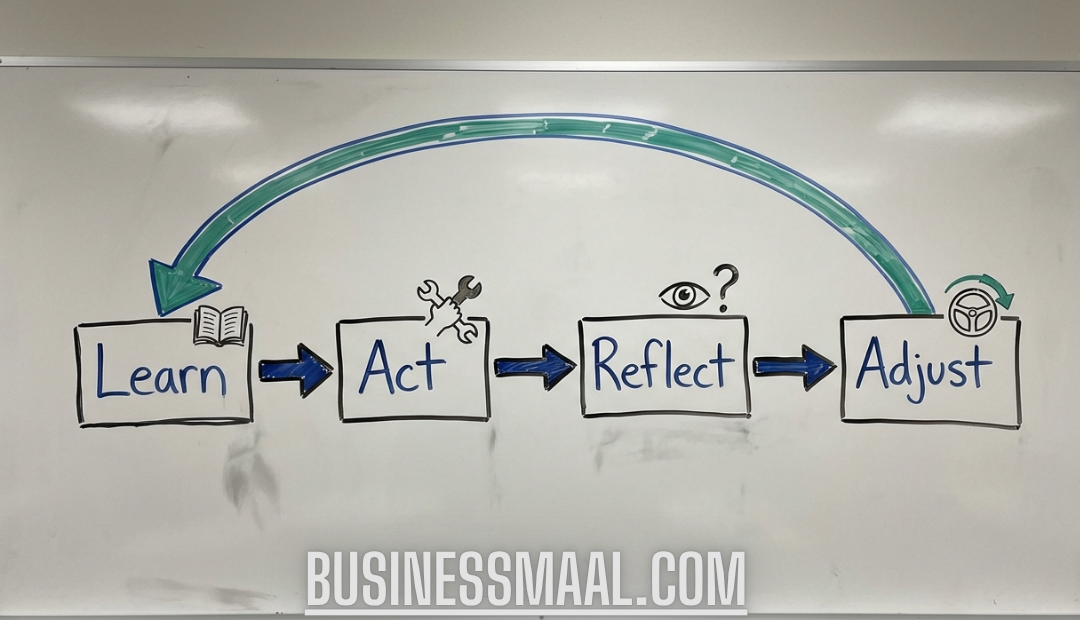
Learn 20%. Get just enough to take one step.
Act 80%. Do the thing, even if it’s messy.
Reflect. What worked? What didn’t?
Adjust. Change one small thing.
Repeat.
That’s duaction explained in five lines.
Let’s Get Real for a Second
I’m not saying learning is bad. I love books. I take courses. Good information is gold.
But information without action is just entertainment.
You’ve probably read hundreds of blog posts this year. Watched dozens of YouTube videos. Saved countless “helpful” threads.
And you’re still stuck in the same place.
Not because you’re lazy. Because you’ve been taught that preparation comes before action. But the real world doesn’t work that way.
The perfect balance is messy, small, and starts today.