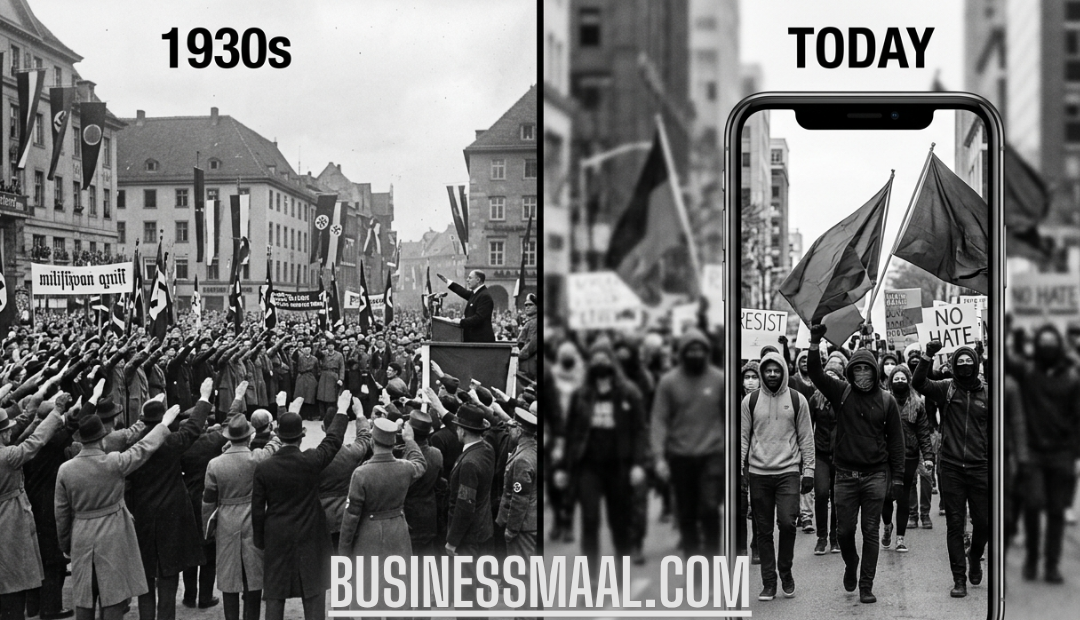
Let me be real with you. I used to think “fascist” was just a word people threw around online when they lost an argument.
You know what’s crazy? I was wrong.
Last month, I found myself scrolling through the news at 11 PM, feeling that familiar knot in my stomach. Another rally. Another leader testing the limits. Another comment section calling everyone names without understanding what the word even means.
So I did what I always do when I get confused. I went back to the books. I looked at the history. And I realized something important.
Fascism isn’t a costume from the 1930s. It’s a living playbook. And it keeps getting performed, scene by scene, all over the world.
Today, I want to walk you through what fascism explained simply actually looks like. Where it came from. How it spreads. And why understanding this matters more than your Netflix queue right now.
Grab your coffee. This one’s important.
What Exactly Is Fascism? (And Why It Matters Today)
Here’s the thing most people miss.
Fascism isn’t just about swastikas or black boots. That’s the costume. The real ideology is sneakier.
I think of fascism as a political virus. It doesn’t announce itself with a marching band. It whispers three things:
We were once great.
They took it from us.
I alone can fix it.
Sound familiar? That’s by design.
At its core, fascist ideology demands total control. Not just over laws—over what you read, who you love, and what you’re allowed to say. It builds a cult around a strongman leader. It turns “the other” (immigrants, minorities, political rivals) into a monster. And it calls violence patriotic.
Here’s a quick breakdown of the main traits:
Ultranationalism – My country is always right, no matter what.
A single, glorified leader – Questioning them is treason.
Scapegoating – All your problems are their fault.
Propaganda as truth – Repeat the lie until it feels real.
Rejection of democracy – Elections? Too slow. We need action.
I’ve watched this playbook get dusted off and reused in country after country. And every time, people say, “It can’t happen here.”
That’s exactly what they said in 1930s Germany. And Italy. And Spain.
How Fascism Took Hold (And Why It Worked)
Let me tell you a short story.
My grandfather wasn’t a politician. He was a farmer in a small European town. When the Depression hit, he lost almost everything. Then a man in a nice uniform came to town. He pointed at the neighbors down the road and said, “They’re why you’re poor.”
My grandfather told me, “It felt good to have someone to blame. For about six months. Then the trucks came.”
That’s the terrifying genius of the rise of fascist ideology. It doesn’t start with gas chambers. It starts with anger and hope twisted together.
After World War I, Germany was humiliated and bankrupt. Italy felt cheated by the peace treaties. Spain was deeply divided. People were desperate. And desperate people will trade freedom for a scapegoat every single time.
Benito Mussolini (yes, he coined the term “fascism” in 1915) promised to restore Roman glory. Adolf Hitler promised to make Germany strong again. Both used the same tools:
Economic fear – “Those people are stealing your jobs.”
Media control – “Only we tell the truth.”
Rallies and symbols – Belonging feels powerful.
A secret police – Disappear if you complain.
It took less than a decade for both countries to go from democracies to nightmares. And here’s what keeps me up at night: it could happen anywhere.
Global Impact: We’re Still Feeling It
You might think, “That was 80 years ago. We’re smarter now.”
Are we?
The global impact of fascism isn’t just history homework. It’s showing up in real time.
Hungary – Viktor Orbán has openly called for an “illiberal state.” He controls the media, rewrites election laws, and frames migrants as invaders.
Brazil – Under Bolsonaro, we saw military parades, attacks on the press, and praise for past dictatorships.
India – Hindu nationalism has grown more aggressive, with Muslim citizens increasingly treated as second-class.
The United States – January 6th wasn’t just a riot. It was a fascist rehearsal. A crowd trying to overturn an election for a leader who refused to leave.
I’m not saying every conservative is a fascist. That’s lazy thinking. But I am saying the warning signs are blinking red, and too many of us are pretending it’s just a weird light.
Fascism doesn’t need a majority. It needs apathy. It needs good people to say, “That’s not my fight.” And it needs you to believe the monster always wears a black uniform.
Sometimes, the monster wears a suit. Or a flag pin. Or your uncle’s face at Thanksgiving dinner.
Signs of Fascist Ideology to Watch For Today
Okay, let’s get practical. You want to know how to spot this stuff in the wild. Here’s what I watch for. You can use this list today.
The “One Enemy” Speech
If a leader keeps pointing at a single group (immigrants, journalists, a political party) and saying they’re the source of all pain? Red flag. Fascism needs a villain.
Attacks on Free Press
“Fake news” isn’t just a phrase. It’s a weapon. When leaders try to shut down or discredit journalists who criticize them, they’re following the playbook.
Celebrating Violence
Look for supporters who cheer when protesters get hurt, or when the military is used against citizens. Fascism loves “order” more than justice.
Rewriting History
They’ll say the past was glorious. They’ll erase the bad parts. They’ll tell you “we were never this divided until they showed up.”
Loyalty Over Truth
The leader can do no wrong. If they lie, it’s “strategy.” If they break the law, it’s “fighting the system.” Your job is to obey, not think.
I check my own news feed against this list every few weeks. It’s sobering. Try it.
What Can You Actually Do About It?
I’m not here to scare you without giving you a flashlight. So here’s what I tell my own friends when they ask, “What can I do?”
First, stay informed from real sources.
Not TikTok clips. Not rage-bait headlines. Read reputable journalism and historical accounts like those from the United States Holocaust Memorial Museum. Understand what actually happened last time.
Second, talk to people without screaming.
I know it’s hard. But dehumanizing the other side just feeds the fire. Ask questions. Share what you’ve learned gently. You don’t win hearts by calling everyone a Nazi.
Third, support local democracy.
Go to a school board meeting. Vote in primaries. Know your mayor’s name. Fascism thrives when national government feels distant and broken. Strong local communities are the antidote.
Fourth, don’t normalize the unthinkable.
When someone jokes about “rounding them up,” don’t laugh. Say, “That’s not funny. That’s how it starts.” Be the person who breaks the silence.
Let’s Keep This Conversation Going
Look, I didn’t write this to ruin your day. I wrote it because I love this whole messy, complicated experiment called democracy. And I’ve seen too many people sleepwalk into darkness while arguing about sports and reality TV.
Fascism explained simply isn’t a monster under the bed. It’s a choice. A series of small decisions to look away, to blame someone else, to hand over power because thinking is hard.
But here’s the good news. You’re not powerless. You’re reading this. You’re paying attention. And that’s the first step.
Have you noticed any of these warning signs in your own community? I’m genuinely curious. Drop a comment below or share this with someone who needs to read it.